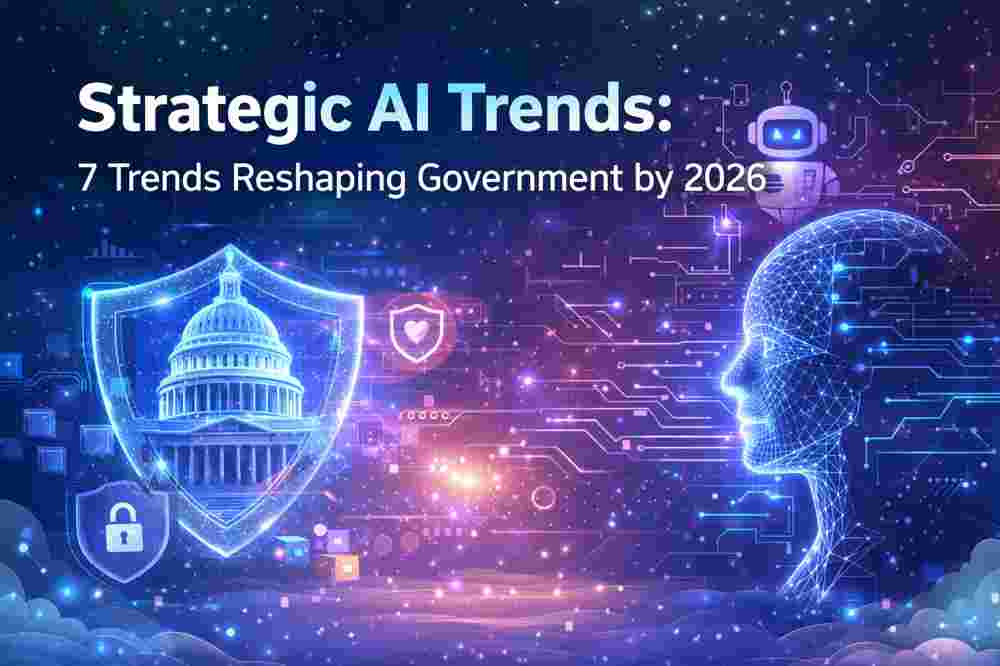
For decades, the public sector has often been synonymous with bureaucracy, slow processes, and legacy systems. Yet, beneath this traditional image, a silent revolution is underway. AI trends in government are transforming how public services operate. Artificial Intelligence (AI) is no longer a futuristic concept; it is rapidly becoming the catalyst reshaping how governments operate, deliver services, and engage with citizens.
By 2026, AI won’t just be an optional add-on; it will be a fundamental component of effective governance. This is not merely about digitizing old processes; it’s about fundamentally reimagining them. From city halls to federal agencies, AI is promising a future where public services are more efficient, responsive, equitable, and intelligent.
The Foundational Shift: Why AI Matters to Government
The imperative for AI adoption in the public sector stems from several critical drivers: an explosion of data that humans alone cannot process, an ever-increasing demand for efficiency in the face of limited resources, and evolving citizen expectations for seamless, personalized interactions akin to those they experience in the private sector. AI offers the ability to unlock insights from vast datasets, automate tedious tasks, and predict future needs, allowing public servants to move from reactive problem-solving to proactive governance.
7 AI Trends Reimagining Governance by 2026:
1. Hyper-Personalized AI in Public Sector Services
Imagine interacting with your government not through endless forms or confusing phone trees, but via an intelligent system that understands your unique needs. By 2026, AI will drive hyper-personalized citizen services. How AI Improves Citizen Services?
Here is the actionable AI in the public sector:
- AI-powered chatbots and virtual assistants handle routine inquiries for everything from permit applications and tax guidance to welfare assistance, providing instant, 24/7 support in multiple languages.
- Predictive analytics tailoring service recommendations, proactively informing citizens about benefits they qualify for, or guiding them through complex processes based on their profile.
This trend promises to significantly increase citizen satisfaction, reduce the burden on human support staff, and make government services genuinely user-centric.
2. Predictive Policing & Public Safety
AI is transforming public safety by shifting from reactive response to predictive prevention. By 2026, advanced AI systems will analyze vast amounts of data, including historical crime patterns, weather conditions, social media sentiment, traffic flows, and event schedules. This enables law enforcement and emergency services to:
- Predict potential crime hotspots and allocate police resources more effectively.
- Optimize emergency response routes and pre-position resources for anticipated incidents (e.g., medical emergencies during large public gatherings).
- Identify potential risks in urban environments.
While promising enhanced safety and more efficient resource deployment, this trend demands careful navigation of ethical concerns regarding privacy, data bias, and transparency to ensure fair and equitable application.
Top Read Recommendations For You
How to Learn Prompt Engineering
Woman Wins $150000 Lottery Using ChatGPT AI Chatbot But…..
10 Tips To Improve AI Image Text Quality In AI Generated Images
3. Automated Regulatory Compliance & Fraud Detection
Governments lose billions annually to fraud and grapple with the complexities of regulatory compliance. AI is emerging as a powerful antidote. By 2026, AI will be a frontline defender in AI fraud Detection in government systems by:
- Scanning vast datasets of financial transactions, tax filings, and benefit claims to identify suspicious patterns and anomalies indicative of fraud.
- Automating checks against complex regulatory frameworks, ensuring businesses and individuals adhere to laws without exhaustive manual audits.
This trend saves taxpayers billions, reduces human error, and accelerates the processing of legitimate claims and compliance checks, fostering greater trust in public financial systems.
4. AI in Smart Cities – Smart Infrastructure & Urban Planning
Our cities are becoming living laboratories for AI. By 2026, AI will be central to creating smart infrastructure and urban planning. This involves:
- Optimizing traffic flow through real-time analysis of sensor data from roads and public transport.
- Managing public utilities like water distribution, energy grids, and waste collection more efficiently, predicting demand, and identifying leaks or inefficiencies.
- Predicting maintenance needs for critical infrastructure such as roads, bridges, and public buildings, and scheduling repairs proactively to prevent failures and extend asset life.
The benefits are clear: more efficient cities, reduced environmental impact, significant cost savings, and a tangible improvement in the quality of life for urban residents.
Disclaimer: The views expressed in this article are solely those of the author and do not represent any official government position or declaration of policy changes.
5. Intelligent Resource Allocation & Policy Modeling
One of the most profound impacts of AI will be on how governments make decisions. By 2026, AI will enable intelligent resource allocation and sophisticated policy modeling. This means:
- Simulating the potential impacts of new policies (e.g., changes to healthcare funding, education reforms) before implementation, and predicting outcomes for various demographics.
- Optimizing budget allocation for public programs, ensuring funds are directed where they can achieve the maximum positive social impact.
- Predicting future needs, such as hospital bed capacity during flu season, school enrollment rates, or demands on social services, allows for proactive planning.
This leads to data-driven policy decisions, better outcomes for citizens, and more responsible, optimized spending of public funds.
6. AI in Cybersecurity for Government – Cybersecurity & Threat Detection
Government agencies are prime targets for cyberattacks, making robust cybersecurity paramount. By 2026, AI will be indispensable for enhanced cybersecurity and real-time threat detection. AI systems will:
- Continuously monitor vast government networks for anomalies, identifying suspicious activities that evade traditional defenses.
- Detect sophisticated zero-day threats and advanced persistent threats (APTs) by analyzing behavioral patterns rather than just known signatures.
- Respond to cyberattacks with unprecedented speed, isolating threats and mitigating damage in real-time.
This trend ensures stronger protection for critical national infrastructure and sensitive citizen data, bolstering national security and public trust.
7. Ethical AI Governance & Public Trust Frameworks
As AI’s presence grows, so does the critical need for responsible deployment. By 2026, the development of ethical AI governance and public trust frameworks will be a defining trend. This involves:
- Establishing robust ethical guidelines for AI use in all public sector applications, ensuring fairness, accountability, and human oversight.
- Implementing transparency requirements and developing explainable AI (XAI) tools to ensure citizens can understand how AI-driven decisions are made.
- Mitigating algorithmic bias in datasets and models, particularly in sensitive areas like justice and social services, to prevent discrimination.
This trend is crucial for building and maintaining citizen trust, ensuring that AI deployments align with democratic values and serve the public good equitably.
Overcoming the Hurdles: The Path to Successful AI Integration
The path to a fully AI-powered public sector is not without its challenges. Governments must address:
- Data Privacy and Security: Implementing ironclad measures to protect sensitive citizen data.
- Legacy Systems: Modernizing outdated IT infrastructure to integrate AI effectively.
- Talent Gap: Attracting and training public sector employees in AI literacy and data science skills.
- Ethical Considerations: Proactively developing policies to address bias, fairness, and accountability in AI.
- Public Skepticism: Engaging citizens transparently about AI’s benefits and limitations.
Successful AI integration will require careful planning, significant investment in human capital, robust ethical frameworks, and continuous public engagement.
Conclusion: AI Augments, Humanity Inspires
Smart AI trends are fundamentally reshaping the public sector, promising a future of unprecedented efficiency, responsiveness, and citizen-centric services. By strategically embracing these seven trends, governments can move beyond outdated models and build a more intelligent, proactive, and equitable society. The future of governance is not about AI replacing humans, but about AI augmenting human capabilities, allowing public servants to focus on empathy, complex problem-solving, and the uniquely human aspects of serving the public. The time for strategic AI adoption in the public sector is now.
Frequently Asked Questions (FAQ)
1. Generative AI for Efficiency: Using tools to rapidly draft policy summaries, create internal reports, streamline procurement, and improve knowledge management.
2. AI Agents for Service Delivery: Moving beyond basic chatbots to intelligent, autonomous systems that can handle complex citizen inquiries (e.g., checking benefit eligibility, managing permit applications) 24/7.
3. Predictive Analytics for Policy: Applying AI to large datasets (e.g., health, transportation, crime) to forecast future demand, allocate resources proactively, and inform evidence-based policy decisions.
AI enables hyper-personalized services, allowing government platforms to deliver tailored information, language support, and guidance based on an individual’s specific needs. It also automates routine back-office tasks, freeing up human staff to focus on complex cases and empathy-driven interactions, ultimately reducing wait times and improving service accuracy.
Here are the primary challenges that we think the government is facing in adopting AI fully into the system:
Talent and Skills: A shortage of public sector employees with the necessary data science, AI engineering, and AI ethics expertise.
Legacy Systems: Integrating modern, data-intensive AI solutions with outdated and siloed government IT infrastructure.
Budget Constraints: Difficulty in securing the sustained funding needed for AI research, deployment, and ongoing maintenance.
The public sector must prioritize these ethical and governance issues to use AI with more responsibility:
Bias Mitigation: Proactively identifying and eliminating systemic biases within AI models that could lead to inequitable outcomes in areas like criminal justice or social services.
Transparency and Explainability (XAI): Ensuring citizens understand how an AI system arrived at a decision, especially in high-stakes contexts, to maintain public trust and accountability.
Data Security and Privacy: Implementing stringent protocols to protect the highly sensitive personal and national security data used to train and operate government AI systems.
AI is expected to augment the public sector workforce. It automates repetitive administrative tasks (data entry, form processing), allowing civil servants to shift their focus to higher-value activities: complex problem-solving, policy design, community engagement, and exercising uniquely human judgment. New roles, like “AI Governance Officers” and “Mission Rapid Prototypers,” are emerging to manage and deploy these tools.